
Sub-Total: €0.00
The Ayurveda Tradition
Ayurveda—from ayur, meaning “life,” and veda, meaning “science or knowledge”—is an ancient theory of mind-body wellness that dates back more than 5,000 years to ancient India. The guiding principles of the Ayurvedic diet are balance and nourishment, both of the body and mind. According to the Ayurvedic doctrine, nourishing the body nourishes the soul—and vice versa—leading to better overall wellness.
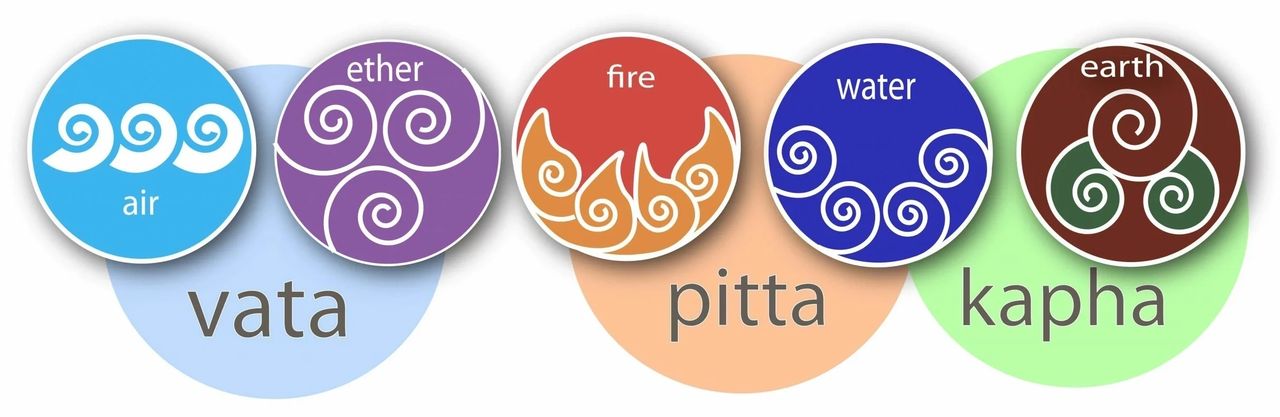
Ayurveda categorizes everything – our minds, bodies, food, energy – as comprised of a mix of five basic elements.
- Ether is the space in which everything happens. It is the field that is simultaneously the source of all matter and the space in which it exists. Ether is only the distance that separates matter. The chief characteristic of ether is sound. Here, sound represents the entire spectrum of vibration.
- Air is the gaseous form of matter, which is mobile and dynamic. Within the body, air (oxygen) is the basis for all energy transfer reactions. It is a key element required for fire to burn. Air is existence without form.
- Fire is the power to transform solids into liquids, into gas, and back again. In other words, it possesses the power to transform the state of any substance. Within our bodies, the fire or energy binds the atoms together. It also converts food to fat (stored energy) and muscle. Fire transforms food into energy. It creates the impulses of nervous reactions, our feelings, and even our thought processes. Fire is considered a form without substance.
- Water characterizes change and represents the liquid state. Water is necessary for the survival of all living things. A large part of the human body is made up of water. Our blood, lymph, and other fluids move between our cells and through our vessels, bringing energy, carrying away wastes, regulating temperature, bringing disease fighters, and carrying hormonal information from one area to another. Water is a substance without stability.
- Earth represents the solid state of matter. It manifests stability, permanence, and rigidity. In our body, the parts such as bones, teeth, cells, and tissues are manifestations of the earth. Earth is considered a stable substance.
These five elements are constantly in a state of flux. Using Ayurveda, we can establish which elements are dominant, and thus exert more influence over the body and mind, and then use the individualized lifestyle prescriptions (wisdom) of Ayurveda to help us strike that balance in all aspects of life.
Ayurveda is a sister science to Yoga:
- The path to perfect health parallels (ayurveda) the path to enlightenment (yoga)
- Ayurveda rejuvenates the Body, and Yoga purifies the Mind and Consciousness
- Ayurveda teaches us that everything we take in through our senses will either bring us to balance or out of balance
Basic Principles:
Practitioners of Ayurveda believe that the mind and body are connected and there are three different mind-body types or Doshas – Vata, Pitta, and Kapha. Everyone has a unique mix of these Doshas which control various bodily functions, but most people are dominated by one. The main goal of practicing Ayurveda is to balance all three Doshas so that your body and mind function at their healthiest.
Ayurveda emphasizes balance, prevention, and self-healing. Ayurveda encourages you to be an active participant in your own journey towards healing. It is a system of holistic healing, because it looks at the whole picture of total health: unity of mind, body and spirit.
The Ayurvedic approach to cooking developed over thousands of years, and is based on the experience of millions of people. It boasts a rich understanding of the various effects that foods can have on a person’s health. It also capitalizes on the tremendous bounty of vegetables, fruit, nuts, grains, and spices traditionally available in the Asian sub-continent. It views all of these items not just as sources of sustenance and flavor, but as the foundation for good health, physically, mentally, and spiritually.
You do not just become the food you eat by virtue of the activity of your digestive system; you recognize that you, the eater, are also the food you are eating.
Your constitution “prakruti” is important to know:
- Who I am? (On the basis of my vata, pitta, kapha constitution)
- What should I eat?
- What should I avoid?
- What should I eat in moderation?
- What should I eat occasionally?
- What should I follow in my lifestyle?
The answer to these questions can help us to have proper choice regarding our diet and lifestyle and stay healthy.
Prakruti is your body constitution/body type. It is the key determinant of how one individual is different from other. Ayurveda describes the interaction of three essential energy complexes, known as the “Doshas” that govern our mind and body, creating a blueprint to support our health and vitality.
These doshas are derived from five elements of nature: air, water, earth, space/ether and fire. Out of these elements derive the three Ayurvedic doshas:
- “Vata” (air/space-ether)
- “Pitta” (fire/water) and
- “Kapha” (water/earth).
Ayurveda also observes the five elements within the human body. We nourish ourselves with foods from the Earth, and eventually, our body returns to the earthly matter from which it came. Water is our life-sustaining nectar, making up more than 70 percent of our total body mass. Fire provides the body with heat and radiant energy and exists within all metabolic and chemical actions. Air flows freely throughout the body, giving movement to biological functions and feeding every cell with oxygen. Space/ether is ever-present, humbly residing in the background, providing the other elements with an opportunity to interact in this way. Balance of the three ensures complete state of physical and mental well-being.
Vikruti – The State of Imbalance:
Overtime our unique constitution (prakruti) is influenced by and reacts to various factors such as:
- Age, lifecycle (Childhood-Kapha stage of life, Adulthood-Pitta stage of life, Old age-Vata stage of life)
- Geographical Location
- Climate/ Seasons
- Diet
- Lifestyle
- Medicine
When imbalance (vikruti) occurs, this means that one of more of the dosha becomes aggravated, which in turn disturbs the digestive fire (agni), and therefore results in toxic unprocessed food (ama). These toxins block the bodily channels (srotas) and is deposited in the tissues (dhatus) where disease manifests.
About the Doshas:
Vata
This dosha derives from the elements of space and air and translates as “that which moves things.” It is the energy of movement and the force governing all biological activity. Vata is often called the “King of the doshas,” since it governs the body’s greater life force and gives motion to Pitta and Kapha.
The qualities of Vata are those of ether and air: It is dry, rough, light, cold, subtle, and mobile.
Accordingly, Vata universally governs anything related to movement, such as breathing, talking, nerve impulses, movements in the muscles and tissues, circulation, assimilation of food, elimination, urination, and menstruation.
Psychologically, Vata governs communication, creativity, flexibility, and quickness of thought.
If Vata is dominant in your body and moves out of balance, you experience excess “air” in your body. In a lot of cases, this is exactly how it feels: Bloating, gas, indigestion. It can also manifest as anxiety (fast movement of thoughts), dry skin, constipation, poor circulation and a feeling of ungroundedness.
Pitta
This dosha derives from the elements of fire and water and translates as “that which cooks things.” It is the energy of digestion and metabolism in the body. While Pitta is most closely related to the element of fire, it is the liquid nature of these substances that accounts for the element of water in pitta’s make-up.
The qualities of Pitta are predominantly those of fire: It is oily, sharp, hot, light, moving, liquid, and acidic.
Accordingly, it’s Pitta that provides the body with heat and energy through the breakdown of complex food molecules. It governs all processes related to conversion/transformation throughout the mind and body. Psychologically, Pitta governs joy, courage, willpower, anger, jealousy, and mental perception. It also provides the radiant light of the intellect.
If Pitta is dominant in your body and moves out of balance, you experience excess heat and inflammation in the body. It can show up as rashes, excess sweating, heartburn, diarrhea, acid reflux, ulcers, impatience and irritability.
Kapha
This dosha derives from the elements of earth and water and translates as “that which sticks.” It is the energy of building and lubrication that provides the body with physical form, structure, and the smooth functioning of all its parts. Kapha can be thought of as the essential cement, glue, and lubrication of the body in one.
The qualities of Kapha are those of water and earth: It is moist, cold, heavy, dull, soft, sticky, and static.
Accordingly, Kapha moistens food, gives bulk to our tissues, lubricates joints, stores energy, and relates to cool bodily fluids such as water, mucus, and lymph.
Psychologically, Kapha governs love, patience, forgiveness, greed, attachment and mental inertia. With its earthly makeup, Kapha grounds Vata and Pitta and helps offset imbalances related to these doshas.
If Kapha is dominant in your body and moves out of balance, you can experience mucus build up that translates into allergies, asthma and respiratory problems, water retention, lethargy and heaviness (especially after meals).
Vata, Pitta, or Kapha?
The combination of your Doshas is essential for your health. When you know what constitution you have, you better understand why you are the way you are at times. You discover what nutrition is suitable for you and how you can stay healthy, fit, and happy with yoga, exercise, and meditation.