
Sub-Total: €0.00
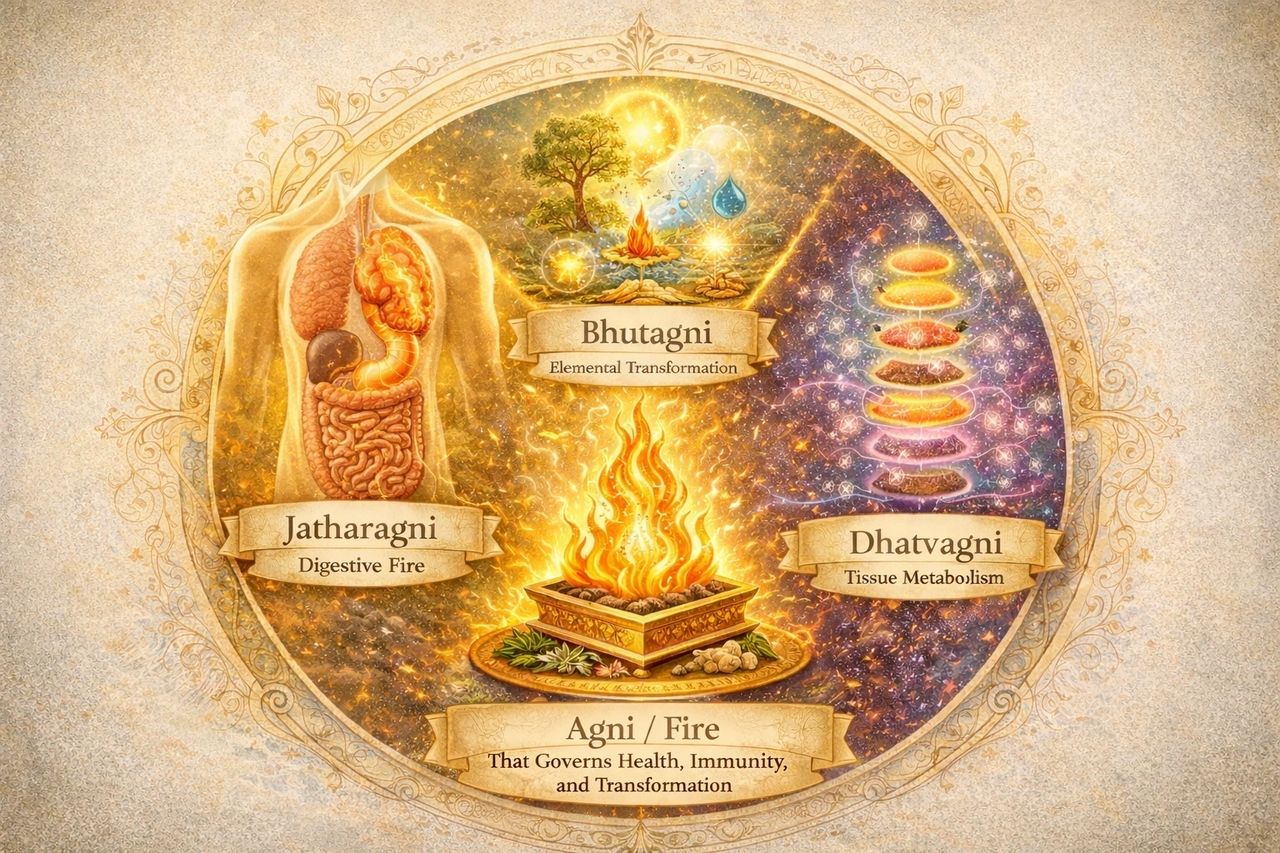
An Advanced Understanding of Agni
The Intelligent Fire That Governs Health, Immunity, and Transformation
In Ayurveda, Agni is far more than digestion. It is the principle of transformation itself, governing how we digest food, metabolize experiences, assimilate nutrients, process emotions, and sustain immunity.
When Agni is balanced, the body is resilient, the mind is clear, and immunity (Ojas) is strong. When Agni is disturbed, imbalance spreads quickly across tissues and systems. For this reason, correcting Agni is central to all Ayurvedic healing, but it must be done with precision, context, and restraint.
The Interdependence of Jatharagni, Bhutagni & Dhatvagni
Ayurveda describes 13 Agni’s, working in a precise and interdependent sequence.
1. Jatharagni – The Central Digestive Fire
Located in the gastrointestinal tract, Jatharagni governs the digestion of food into absorbable essence. It sets the tone for all downstream metabolic processes.
If Jatharagni is weak, erratic, or excessive, all other Agnis are affected.
2. Bhutagni – Elemental Transformation
There are five Bhutagnis, each responsible for metabolizing one of the five elements—earth, water, fire, air, and ether—present in food.
Bhutagni transforms digested food into elemental forms that the body can recognize and utilize. Even when Jatharagni appears “normal,” impaired Bhutagni can lead to subtle malabsorption, inflammation, or imbalance.
3. Dhatvagni – Tissue-Level Metabolism
Each of the seven tissues (dhatus) has its own Agni, responsible for transforming nutrients into healthy tissue and appropriate byproducts.
When Dhatvagni is impaired:
- Tissues may become depleted or excessive
- Ama accumulates at the tissue level
- Disease manifests chronically
Key Principle:
Healthy digestion does not guarantee healthy tissue metabolism. All Agnis must function in harmony.
Agni Is Variable, Not Fixed
One of Ayurveda’s most sophisticated insights is that Agni is dynamic, constantly responding to internal and external conditions.
Across the Lifespan
- Childhood: Developing, delicate Agni
- Adulthood: Stronger, more resilient Agni
- Later life: Naturally declining Agni with increased Vata
Treatments must adapt accordingly.
Across Seasons
- Winter: Agni is naturally stronger but easily burdened
- Summer: Agni weakens due to heat
- Spring: Kapha dampens Agni
- Fall: Vata destabilizes Agni
Ignoring seasonal influence is a common cause of imbalance.
Across Constitution (Prakriti)
- Vata: Variable, irregular Agni
- Pitta: Strong but prone to excess
- Kapha: Slow, steady, but heavy Agni
Correcting Agni without honoring the body constitution often worsens symptoms.

The Classical States of Agni
Agni expresses itself in four primary functional states. Understanding these is essential for accurate assessment and treatment.
1. Sama Agni – Balanced Fire
This is the ideal state.
- Stable appetite and digestion
- Clear perception and focus
- Emotional resilience
- Efficient elimination
- Strong immunity (Ojas)
Sama Agni reflects harmony between all doshas and tissues.
2. Vishama Agni – Irregular Fire
Traditionally associated with Vata, Vishama Agni is characterized by instability rather than weakness or strength.
It manifests as inconsistency in:
- Digestion
- Energy levels
- Mood and focus
- Sleep patterns
- Appetite and motivation
A person with Vishama Agni may digest well one day and poorly the next, feel inspired one moment and depleted the next.
This instability is often neurological and systemic, not merely gastrointestinal.
3. Manda Agni – Sluggish Fire
Associated primarily with Kapha, Manda Agni reflects low metabolic intensity.
Common features include:
- Slow digestion and heaviness after meals
- Lethargy and low motivation
- Weight gain or fluid retention
- Excess mucus or congestion
- Dull appetite
With Manda Agni, food is not fully transformed, leading to Ama accumulation. Importantly, stimulating Agni aggressively in this state often worsens symptoms by overwhelming an already burdened system.
4. Tikshna Agni – Sharp or Excessive Fire
Associated with Pitta, Tikshna Agni reflects overactive metabolism.
Common features include:
- Strong appetite with irritability when meals are delayed
- Acid reflux, heartburn, or loose stools
- Heat intolerance and inflammation
- Anxiety, impatience, or intensity
- Tendency toward burnout
While digestion may appear “strong,” Tikshna Agni often burns tissues and Ojas, leading to depletion over time.
Agni, Ojas & Immunity
In Ayurveda, Ojas is the refined essence of all seven dhatus and the foundation of immunity, vitality, and emotional stability.
Agni and Ojas have a direct and delicate relationship:
- Balanced Agni → Proper tissue nourishment → Strong Ojas
- Impaired Agni → Ama accumulation → Depleted Ojas
Crucially, overstimulating Agni can destroy Ojas, resulting in exhaustion, anxiety, inflammation, and weakened immunity.
This is why aggressive detoxes, excessive fasting, and over stimulation often backfire, especially in chronic or sensitive individuals.
Clinical Focus: Correcting Agni Without Provoking Imbalance
The goal is not to increase Agni indiscriminately, but to stabilize and regulate it.
Key Clinical Principles
- Nourish before stimulating
- Stabilize before cleansing
- Address Vata first in chronic cases
- Support rhythm, not intensity
Gentle measures, warm meals, regular routines, appropriate fats, mindful eating, and seasonal awareness often restore Agni more effectively than strong interventions.
True healing occurs when Agni is supported intelligently, allowing the body to self-correct.
Closing Reflection
Agni is not a flame to be forced; it is an intelligence to be understood.
When we honor its variability, protect its subtlety, and work with precision, Agni becomes our greatest ally in healing.
Balanced Agni sustains life.
Reckless Agni depletes it.