
Sub-Total: €0.00
Walking with the Divine – Through the Sacred Himalayas
Walking with the Divine: A Soul’s Journey Through the Sacred Himalayas
May 27 – The beginning of my Yatra
I wrapped up my work with Mohitji and work meetings in Karnāl by around 3 PM and booked a driver to take me to Kainchi Dham in Bhowali. This marks the beginning of my 10-day Yatra—a journey both spiritual and personal.
My pilgrimage starts with blessings from the Neem Karoli Baba temple in Bhowali. From there, I plan to travel to Haridwar, Rishikesh, Badrinath, Kedarnath, and back to Rishikesh. I’ve been told this Yatra is physically and mentally demanding. I haven’t booked any hotels, as the timing of each stop is uncertain. But I’m guided by deep faith, trusting the universe to lead the way.
About an hour into the drive, I tried to rest, but it was difficult. The roads are narrow, winding, and rough, filled with the constant sound of honking. Facilities are minimal—no proper restrooms—and we passed fields of sugarcane as we journeyed deeper into the countryside.
Four hours in, we stopped at a bustling local market filled with fruits, vegetables, and spices. I picked up some fruit and treated myself to a sugarcane juice with ginger and lemon—absolutely refreshing.

Back on the road for another stretch, about four more hours. The rural scenes are vivid—bullock carts, freely roaming cows, crowded rickshaws. India’s cultural richness pulses through every village and roadside.
I managed to catch a short 30-minute nap and did some breathing exercises to recenter myself. At 8:45 PM, with still no hotel booked, we continued the drive. The uncertainty of travel times made it hard to plan accommodations in advance.
Passing through hill station towns slowed us down. Finally, we arrived at 11:34 PM—exhausted. We found a small roadside hotel home-stay and called it a night. The journey has only just begun.
May 28 – With Neem Karoli Baba: A Journey Inward and Outward

Our day began early—5 a.m.—as we set out to receive Darshan and attend the morning Aarti at the Neem Karoli Baba temple in Kainchi Dham, near Bhowali. The journey leading up to this sacred moment had already been filled with spiritual echoes. From the serene beauty of Nainital—its shimmering lake and mountain air calming the mind—we traveled on to Bhowali, where the famed ashram of Neem Karoli Baba is nestled amidst the Himalayan foothills.
As we approached the temple that morning, a sacred hush lingered in the cool mountain air. Pilgrims stood patiently, chanting the Hanuman Chalisa in low, reverent voices. And then, stepping into the temple and receiving Darshan, I felt something shift within me. My eyes filled with tears—tears born not of sorrow, but of overwhelming gratitude. After journeying so far, to be here, in the presence of Baba’s energy, felt like a soul-level homecoming. A moment outside of time.
By 6 a.m., we were fully immersed in the Aarti. The ringing of bells, the golden lamps, the fragrance of incense—it was as though heaven and earth met in that sacred courtyard. I closed my eyes and let the rhythm carry me inward. In that moment, I wasn’t merely a visitor—I was devotion itself. I was grace. I was love.

Afterwards, I rested briefly—just half an hour—but even in rest, the stillness stayed with me. I reflected on Neem Karoli Baba, also known as Maharaj-ji, a mystic saint who inspired countless devotees worldwide, including Ram Das, Krishna Das, and other Western seekers who helped spread his teachings. Known for his boundless love and deep silence, Baba taught not through words, but through presence. His simple instructions, “Love everyone, serve everyone, remember God,” echo as eternal truths.
A Prayer from the Heart:
O beloved Neem Karoli Baba, Grant me the strength to walk the path of dharma, with faith, compassion, and unwavering devotion.
O Hanuman, son of the wind, Ocean of wisdom and power, may your courage fill my heart, may your humility ground my soul, and may your service inspire my every action.
Hold me in your grace, and lift me in your presence.
Guide me to surrender fully, to live in truth,
And to remember: love is the way. May your blessings protect and uplift all beings.
From Bhowali, we began the next phase of our journey: a six-hour drive toward Haridwar. Along the way, we stopped at Har Ki Pauri, one of the most sacred ghats on the banks of the Ganga. As the river flowed endlessly before us, I offered silent prayers. Standing at that ancient site of pilgrimage, I felt the continuity of countless generations of seekers who had stood right there, seeking the same blessings, the same peace.
After the ghat, we exchanged cars and drivers, completed our yatra registration, and began the ascent toward Kedarnath, one of the holiest Shiva temples in India and a key site on the Char Dham pilgrimage. Around 4:30 p.m., the rain began to fall heavily, washing the mountains in mist and reverence. We drove for a few more hours, the winding roads drawing us deeper into the Himalayas.
By 8:30 p.m., we stopped for the night just past Devprayag, where the Bhagirathi and Alaknanda rivers meet to form the Ganga. There, in the hush of the mountains and the steady sound of rain, I was reminded again: while we travel to sacred places, the true pilgrimage is always within. Each temple visited is a mirror. Each step forward is also a step inward—toward remembrance, humility, and surrender.
Every river, every bell, every stone path whispers the same sacred truth: You are not alone. The divine walks with you, breathes with you, waits patiently for you to turn inward.
Neem Karoli Baba once said, “The best form to worship God is every form.” And on this journey—from Nainital to Bhowali, from Haridwar to Kedarnath—I am learning to see God not just in idols and temples, but in the clouds, in the driver’s smile, in the individuals who have accommodated me in the humble home-stays of the mountains, in my own breath, and in the tears that come when the soul remembers its source.
May 29 – A Sacred Ascent to the Abode of Shiva
The day began in the predawn silence of 5:00 AM, wrapped in the serenity of the Himalayan foothills. A gentle session of meditation and pranayama (breathing exercises) ushered in the morning, harmonizing body and mind before we took a leisurely stroll along the riverside. The Ganga—ancient, sacred, and ever-flowing—glimmered in the early light, flanked by the rising silhouettes of the Garhwal Himalayas. We sipped on light chai with rusks, a humble breakfast that felt deeply rooted in the rhythm of this land.

By 9:00 AM, we had set out on our pilgrimage to Kedarnath, one of the holiest sites in the Char Dham Yatra and a place steeped in legend. My driver, Guddu, was not merely transporting me—he was guiding me with the care of a local deeply connected to the sacredness of this route.
The heat of the day intensified quickly, yet it did little to diminish the spiritual current that coursed through the roads, now alive with fellow yatris (pilgrims) walking, chanting, and moving in reverent purpose. Each turn offered glimpses of mountain villages nestled among the hills, their colorful homes clinging to cliffs, radiating warmth and simplicity. Along the way, roadside stalls provided water in traditional clay pots, and small chai shacks served up steaming cups of tea and simple meals—fuel for the soul as much as the body.
We paused at the Bhairavi Devi Temple, situated beside a river, for darshan. Bhairavi, a fierce and protective form of the Goddess, is believed to guard the path to Kedarnath. Her presence here felt powerful and grounding—a moment to ask for strength before ascending further.
As we crossed Sersi, the landscape shifted dramatically. The altitude increased, and with it, the air grew crisper. The mountains here cradle entire villages; each house painted in vivid hues that contrast beautifully with the muted greens and greys of the terrain. It felt as though the land itself was ascending with us, carrying us upward in waves of devotion.
By 12:45 PM, we arrived in Guptkashi, a spiritually significant stop. I visited the Vishwanath Temple. This sacred site is believed to be where Lord Shiva concealed himself when fleeing the Pandavas in the Mahabharata. I performed both Abhishek Pooja (a ritual bathing of the Shiva Lingam) and Pitru Pooja—a ritual offering to the ancestors. The connection to lineage, divinity, and time felt palpable.
At around 2:00 PM, we halted near Phata, a quiet village often used as a base for helicopter pilgrimages to Kedarnath. Here, we rested at a modest homestay run by a very special mountaineer and incredible human being, Sarvaheet Karan — a deeply rooted yogi with a quiet strength and warm spirit. Over a nourishing lunch of khichadi and Kadhi — a simple, grounding dish of lentils and rice — we shared an unexpectedly deep and moving conversation about the spiritual journey.
Surrounded by majestic peaks and deep valleys, I sat with awe at the harmony of devotion, nature, and history converging in this landscape. The vibrant homes, the ancient trails, and the timeless chants all seemed to whisper the same message: the divine is near.
Tomorrow marks the climax of this journey—Kedarnath itself, where I will rise at 2:00 AM to make the final leg of this pilgrimage. For now, I rest, held by the silence of the mountains and the promise of what lies ahead.
May 30 – Kedarnath Temple: A Journey of Faith, Grit, and Grace

Embarking on the Kedarnath-Badrinath pilgrimage, known as the Do Dham Yatra, in the majestic Himalayas of Uttarakhand is no ordinary feat. Deeply sacred and spiritually charged, these sites form part of the revered Chota Dham Yatra in Hinduism.
My day began early — 2 a.m. — with meditation and a quiet moment over green tea prepared by Sarvaheet before setting off toward Sonprayag and Gaurikund. Sarvaheet had personally arranged for my breakfast sandwiches and water bottles to be packed at 2 AM before my early departure, a small act that carried immense kindness.
In that moment, I was reminded that the journey is not just about the places we visit, but the souls we meet along the way — and how their quiet acts of compassion stay with us long after the road ends.
I had prepared for this journey both mentally and physically, trusting that faith would carry me through the demanding 24 km trek ahead.
Challenges presented themselves early. Private vehicles were restricted from reaching Gaurikund due to road repairs and recent landslides, forcing an additional 6 km walk. We reached Sonprayag around 3:30 a.m., where the police managed the influx of pilgrims. Local jeeps ferried tourists over dangerously narrow, winding mountain roads riddled with waterfalls and loose stones — a preview of the treacherous path ahead.
As I began this solo pilgrimage, a mix of excitement, reverence, and anxiety welled up within me. I had heard of the grueling terrain, but the reality was far more daunting, testing me physically, emotionally, and spiritually.
I began the official trek from Gaurikund around 4:30 a.m. The path was crowded with pilgrims, horses, mules, and porters carrying the elderly or those unable to walk. The recent rain had turned the trail into a muddy, slippery mess, littered with animal waste and scattered debris. In some places, the path had eroded completely, making the journey even more hazardous.
The first few kilometers were relatively manageable, but the further I went, the more intense it became. The trail was narrow, and the constant dance of dodging animals on ledges with steep drops tested everyone’s focus and patience. At several points, I narrowly avoided collisions with passing horses — reminders of the vulnerability we all shared.
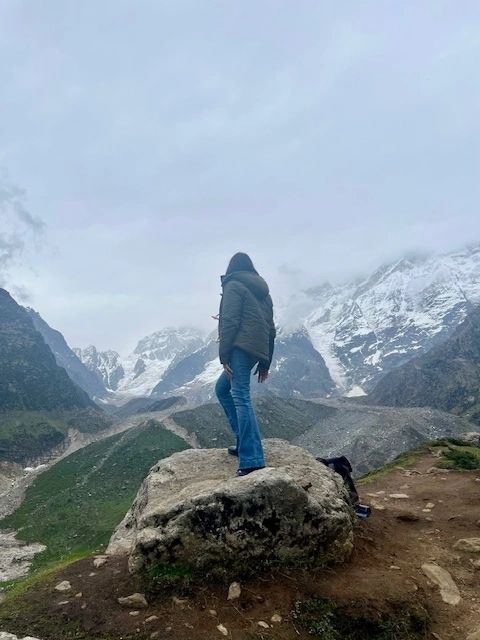
Yet, amid the struggle, there were moments of breathtaking beauty. Snow-capped Himalayan peaks revealed themselves through shifting clouds, offering silent encouragement. Along the way, stalls provided chai, water, food, and fruit, simple comforts that felt like small blessings.
After ten grueling hours, I reached Kedarnath around 2 p.m. The exhaustion I felt instantly gave way to awe. There, standing majestically amidst the towering mountains, was the Kedarnath Temple — a vision I had only ever seen in photos until now. It was a moment of overwhelming emotion and deep gratitude. I had made it.
Despite the long lines for darshan, the energy at the temple was electrifying and restorative. Behind the temple, I sat in meditation near the boulder that famously protected it during the 2013 floods, a powerful symbol of divine grace. Surrounded by the dramatic Himalayan backdrop, I found stillness, calm, and peace.
Later, I made the steep climb to the Bhairavnath Temple, nearly 12,000 feet above sea level. The air grew thinner, but my spirit felt light. From that height, the mountains felt even closer, their silence eternal.
As rain began to fall, I returned to base camp, refueled with chai and a simple meal, and then attended the mesmerizing evening Aarti at 7 p.m. The temple lit up in the twilight, chants filling the air. I went to bed with a full heart, preparing for the descent the next day.
May 31 – The Descent: A Harder Path Than Expected
I started the descent at 3am. I had assumed the descent would be easier, but I was wrong. My body was still fatigued from the previous day, and I hadn’t had time to fully recover.
The trek down was fraught with challenges. The lack of separation between pedestrians and animals, horses, mules, and palanquins made the narrow path dangerous. Congestion was constant. One misstep could have easily led to disaster. A few times, I was shoved by passing horses, falling a few times, and narrowly keeping my balance. The animals, overworked and undernourished, climbed and descended endlessly, often under the harsh direction of their handlers. It was heartbreaking to watch them struggle.
Despite the exhaustion, my heart remained full. The energy of Kedarnath lingered with me, lifting my spirit even as my legs trembled. I made it down by 9:30am. Every time I think back on this journey, my eyes well up. I feel an overwhelming sense of gratitude for the experience, the resilience it called forth, and the divine presence that guided every step.
The Drive to Badrinath
After navigating the chaotic and treacherous mountain roads of Kedarnath, we began our long journey to Badrinath, passing through Guptkashi, Rudraprayag, Karnaprayag, Nandprayag, and Joshimath. Though a shorter alternative exists via Ukhimath and Chopta, the base camp for the sacred Tungnath Temple, part of the Panch Kedar, the narrow, winding path made it unsafe, so we took the more conventional route.
Even though it’s labeled a national highway, the Rudraprayag route proved to be just as grueling. The Kedarnath trek had left me physically exhausted, my body ached, and my knees were nearly giving out. The drive wound through dramatic landscapes and sacred confluences — Rudraprayag, Karnaprayag, and Nandprayag, but was edged with brittle cliffs and loose rocks. Landslides seemed a constant threat, and we drove cautiously through frequent rockfall zones, each stretch a quiet test of endurance and nerve.

We reached Badrinath by late afternoon, nestled high in the Himalayas at over 10,000 feet. The biting cold greeted us once again, echoing Kedarnath’s chill. After checking into our hotel, I walked to the temple. The outer structure of the Badrinath Temple was tranquil and picturesque against the mountain backdrop, but inside, it was crowded and buzzing with pilgrims jostling for darshan.
That evening, I stayed for the evening Aarti, a deeply spiritual and elaborate ritual unique to Badrinath. Unlike ceremonies in many other temples across India, this aarti involves the anointing of the deity with sandalwood paste, which is later distributed among devotees, along with sugar crystals and dried leaves as prasad. Despite the heavy crowd, I managed to find a quiet corner in the temple, where I stood silently for a while, soaking in the atmosphere before returning to the hotel to rest.
A visit to Badrinath Dham is not merely a journey across terrain but a journey inward, toward spiritual awakening. According to Hindu belief, the blessings of Lord Vishnu here bring divine wisdom and protection. In contrast, Kedarnath Dham, associated with Lord Shiva — the harbinger of Moksha — is steeped in asceticism and mythological rigor. Legend holds that Adi Guru Shankaracharya Ji established the Kedarnath temple in the 9th century.
While in Badrinath, we also trekked to Charanpaduka, a sacred rock about 3 km uphill from the temple. It is believed to bear the footprints of Lord Vishnu, marking the divine spot where he stepped down from Vaikunth. The trek was steep and demanding, but the sense of peace at the top was rewarding.
June 1: The Final Leg – Badrinath to Rishikesh
The final leg of our spiritual journey began in the stillness of early dawn. We rose at 4:00 AM — a quiet morning, filled with the kind of silence that only the mountains can offer. After a quick shower and a short meditation, we packed up and set off for Rishikesh.
What should have been an 8–10 hour drive unfolded into a grueling 12-hour expedition. The Himalayan roads, beautiful yet unforgiving, snaked sharply along the edges of cliffs. Driving here requires skill, patience, and a great deal of focus. By the time we arrived in Rishikesh around 6:00 PM, exhaustion had taken its toll.
Barely checked in, the hotel staff urged me to head straight to Triveni Ghat for the Ganga Aarti, a sacred ritual I’d long hoped to witness. Though tired, I didn’t want to miss this final spiritual moment of the trip.

The Ganga Aarti in Rishikesh is unlike anything else — a captivating and deeply moving experience. Devotees gather at the ghats as the sun begins to set, and the atmosphere becomes charged with reverence. Oil lamps are lit, Vedic hymns are chanted, and prayers are offered to the holy Ganges, transforming the riverbank into a sanctuary of light and devotion. There’s a palpable energy in the air, a spiritual pulse that connects everyone present — locals, pilgrims, and seekers alike — in a moment of collective awe.
I returned to the hotel around 8:00 PM, soul-stirred and physically drained. Dinner was a simple, comforting bowl of khichdi, just what the body needed. I went straight to bed, carrying the weight of the journey and the peace of the aarti within me.
June 2: Reflections on the Journey that changed me
Our last day in Rishikesh began before dawn. At 4:00 AM, we set out for a temple tour — a fitting close to a pilgrimage that had already touched so many layers of my being.
The road curled upward through the hills of Tehri Garhwal, still cloaked in night. We parked at the base of Kunjapuri Hill and began the climb up steep stone steps, led only by the faint glow of torches and the silent pull of devotion.
At 1,676 meters (5,499 feet), Kunjapuri Devi Temple is perched like a sentinel watching over the Himalayas. As we reached the top, the sky began to shift from black to indigo, and then to gold.

Just after 6:00 AM, the sun rose behind the distant snow-capped peaks, casting light across the valleys and flooding the temple grounds with warmth. In that sacred stillness, as the world below slowly woke, I felt time pause.
The panoramic view of mountain ranges, river valleys, and far-off ridgelines was nothing short of divine. The temple, dedicated to the goddess Shakti, seemed to radiate a feminine strength, a reminder of the inner power that had carried me through this journey.
The tranquil atmosphere and spiritual ambiance of Kunjapuri stirred something deep within me, a quiet, wordless gratitude for the beauty of life, the grace of faith, and the mystery of the path itself.

After witnessing the breathtaking sunrise at Kunjapuri Devi Temple, our temple tour through Rishikesh continued with visits to some of the region’s most spiritually resonant sites.
We made our way first to the Hanuman Temple, a place pulsing with the energy of devotion and strength. The air was filled with the sound of Hanuman Chalisa, and as I bowed my head before the deity, I felt a wave of renewed courage and grounding – Hanuman’s essence felt very near.
Next, we visited the Neem Karoli Baba Temple in Rishikesh — a smaller but equally powerful echo of the one in Kainchi Dham. The same peace, the same unmistakable energy of love and surrender. It was like returning to a familiar presence, a reminder of where the journey had begun.
From there, we made our way to the Veerbhadra Temple, an ancient Shiva temple believed to be over 1,300 years old. The architecture, the age-worn stones, the silence inside, all whispered of time’s passage and the stillness that endures beyond it. Here, I sat in quiet reverence, grateful for the chance to visit one more seat of Lord Shiva.

Our next destination was something I had longed to experience: the Vashishta Guha Caves, named after the great sage Vashishta. As I stepped into the cave, the air shifted, cool, quiet, and heavy with stillness. The cave was dimly lit, carved deep into the hillside near the banks of the Ganga.
I sat cross-legged in the darkness, eyes closed. Minutes passed. Then an hour. I became unaware of time. There was only breath. Only silence. Only presence. It was one of the most profound meditative experiences I’ve had. The cave seemed to hold centuries of devotion within its walls — an unbroken thread of seekers who had come before me, each in search of the eternal.
Not far from Vashishta Guha, we visited the Arundhati Guha Caves, named after his wife, the revered rishi-patni. Though smaller, the energy here was equally sacred. A quiet reverence hung in the air — a celebration of divine feminine strength and stillness.
The following morning, I began my journey home, heart full and mind quiet. This trip has given me so much to reflect on — it was a test of physical endurance, mental strength, and the ability to embrace the unpredictable.
While the spiritual power of Kainchidham, Haridwar, Kedarnath, Badrinath, and Rishikesh is undeniable, I found myself increasingly concerned about the fragility of Uttarakhand’s environment. The beauty of the Himalayas is sacred, but it’s also under serious threat. The rise in mass tourism has placed an immense burden on this delicate ecosystem. Landslides aren’t caused solely by natural forces — many are accelerated by deforestation, unregulated road widening, and haphazard development. The infrastructure struggles to keep pace with the growing number of pilgrims, and nature often bears the cost.
This pilgrimage was, without a doubt, life-changing. I feel a deep sense of gratitude and accomplishment, but also a lingering anxiety for the future of these sacred sites. As pilgrims, we must ask ourselves: Are our journeys honoring the sanctity and sustainability of these places?
The Himalayas have always been more than a destination — they are a teacher, a mirror, a sanctuary. I feel truly blessed to have experienced this pilgrimage. It’s a memory etched in both body and spirit. My hope is that others, too, will find the same awakening — and the same responsibility — to protect and preserve these timeless places for generations to come.
These mountains are not just backdrops. They are living teachers, ancient guardians of wisdom and balance. We must listen. We must tread lightly. These final visits were not just the end of a journey. They were a reminder: the pilgrimage doesn’t end when you return home — it continues inward, every day, in silence, prayer, and the choices we make.
The pilgrimage is not over. It never really ends.
The Himalayas whispered, and my heart answered. Twice visited, twice enchanted…….
I found it also in sunrises, strangers, tears, and the beat of my own heart.
This was not a vacation. This was a soul journey.
A remembering. A return. A reawakening.
I feel truly blessed. And I carry home not just photos or stories, but a call:
To live more simply.
To walk more consciously.
To serve more selflessly.
To love more fully.
And now, as I begin the journey home, I carry with me not just memories, but a quiet vow:
To honor this path by living with more awareness, more simplicity, more love.
The Himalayas taught me this — in silence, in stone, in sky.
May I never forget.

With Blessings, Love and Gratitude,
Smita