
Sub-Total: €0.00
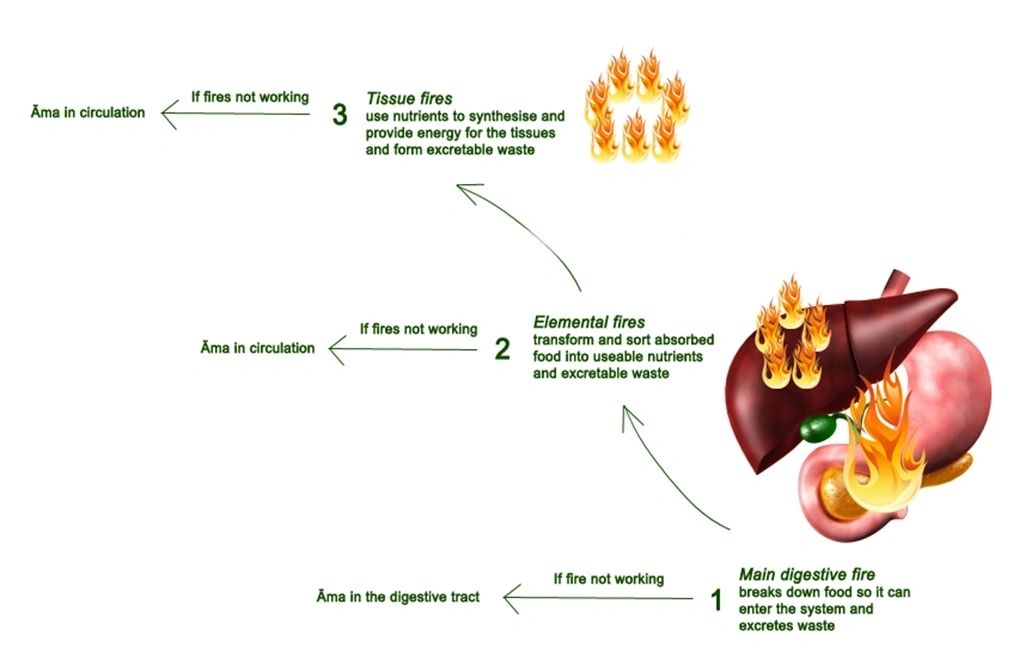
Ama (Toxins): Formation, Types, and Systemic Impact
Understanding the Root of Chronic Imbalance in Ayurveda
In Ayurveda, Ama is not merely a toxin, it is the result of incomplete transformation. Whenever digestion, metabolism, or assimilation is impaired, residue remains. This residue, known as Ama, obstructs physiological intelligence and becomes the root of disease.
While often discussed in digestive terms, Ama exists on multiple levels: physical, metabolic, and psychological. Understanding its formation and movement is essential for effective and sustainable healing.
How Ama Forms
Ama forms when Agni is impaired, whether at the level of digestion, tissue metabolism, or mental processing.
Common contributors include:
- Weak or irregular Agni
- Eating incompatible foods
- Eating when digestion is incomplete
- Suppressed emotions or chronic stress
- Overuse of stimulants, fasting, or detoxification
Ama is not always obvious. In many cases, it remains subtle, slowly impairing function before the disease becomes visible.
Subtle vs Gross Ama – Subtle Ama
Subtle Ama is difficult to detect and often overlooked. It does not produce dramatic digestive symptoms, yet it interferes with cellular intelligence and tissue communication.
Signs may include:
- Fatigue without clear cause
- Brain fog or dullness
- Low-grade inflammation
- Emotional heaviness
- Resistance to treatment
Subtle Ama often precedes chronic disease.
Gross Ama – Gross Ama is more evident and easier to identify.
Signs may include:
- Coated tongue
- Heaviness and lethargy
- Poor appetite or indigestion
- Sticky stools or mucus
- Strong body odor
Gross Ama signals that digestion and metabolism are significantly impaired.
Ama at the Level of Dosha, Dhatu, and Srotas
Ama does not remain localized; it migrates.
Ama and Dosha
When Ama combines with Doshas, it creates a more complex and stubborn pathology:
- Vata + Ama: Pain, bloating, neurological symptoms
- Pitta + Ama: Inflammation, toxicity, irritability
- Kapha + Ama: Congestion, heaviness, metabolic stagnation
This combination is more difficult to treat than doshic imbalance alone.
Ama and Dhatu
When Ama reaches the tissues (dhatus), it disrupts nourishment and tissue intelligence.
This can result in:
- Poor tissue formation
- Degeneration or excess
- Autoimmune-like conditions
- Chronic inflammation
Tissue-level Ama often requires long-term, carefully sequenced intervention.
Ama and Srotas
Ama obstructs the body’s channels (srotas), impairing circulation, elimination, and communication between systems.
Blocked srotas lead to:
- Poor nutrient delivery
- Waste accumulation
- Localized disease patterns
Clearing srotas is a key goal of treatment, but only when the body is ready.
Psychological Ama (Manasika Ama)
Ama is not limited to the physical body.
Manasika Ama forms when experiences, emotions, or impressions are not fully processed. Chronic stress, unresolved grief, mental overload, and suppressed emotions create stagnation in the mind.
Signs may include:
- Mental heaviness or dullness
- Emotional rigidity
- Lack of motivation
- Difficulty letting go
Mental and physical Ama often reinforce one another, creating chronic patterns of imbalance.
Chronic Disease and Latent Ama
Many chronic conditions persist because latent Ama remains embedded in tissues and srotas. Symptoms may wax and wane, but the root cause remains unaddressed.
Latent Ama often becomes active during:
- Seasonal transitions
- Stressful life events
- Aging
- Aggressive detoxification
This is why symptoms can “return” despite treatment.
Clinical Focus: Sequencing Ama-Pachana vs Nourishment
One of the most critical clinical distinctions in Ayurveda is knowing when to reduce Ama and when to nourish.
Ama-Pachana (Digesting Ama)
Indicated when:
- Tongue is heavily coated
- Appetite is low
- Heaviness and lethargy dominate
- Inflammation or congestion is present
Interventions must be gentle and stabilizing, not aggressive.
Nourishment (Brimhana)
Indicated when:
- The body is depleted
- Vata is high
- Ojas is low
- Weight loss, anxiety, or weakness is present
Attempting to clear Ama in a depleted system worsens the disease.
The Golden Rule
Never cleanse without first stabilizing Agni and Vata.
Healing is not about elimination alone; it is about timing, sequence, and intelligence.
Closing Reflection
Ama is not an enemy; it is a message. It signals that something has not been fully received, digested, or integrated.
When approached with precision and compassion, the body releases Ama naturally, restoring clarity, vitality, and resilience.